
How Our Spaced Repetition System Works
Emykhet AkhuJanuary 25, 2025
Overview
Master hieroglyphs effortlessly with our app's unique combination of short initial review bursts and spaced repetition in Precisison Mode. Tailored to the challenges of memorizing intricate glyphs, our system ensures effective retention using proven cognitive science principles like the forgetting curve and spaced learning. Whether you're starting your journey or aiming to perfect your skills, our app is designed to make your learning experience smooth, engaging, and scientifically grounded.
The Science Behind Spaced Repetition
Spaced repetition is grounded in cognitive psychology and aims to improve the retention of information over time by addressing the forgetting curve, a concept first introduced by Hermann Ebbinghaus in 1885. The forgetting curve demonstrates how quickly the brain forgets new information unless it is revisited at strategic intervals. When you first learn something, it’s relatively easy to remember, but as time passes, your memory of it begins to fade. Ebbinghaus's research showed that, without review, about 50% of the information you learn will be forgotten within an hour, and nearly 80% within a day. This rapid decay is why simply learning something once is rarely enough for long-term retention.
This is where spaced repetition comes into play. It involves reviewing information at increasing intervals, strategically timed to combat the forgetting curve. Instead of cramming all at once, you revisit the material just before you're likely to forget it. This "just-in-time" review forces your brain to retrieve the information, which strengthens neural connections and helps the material stick in long-term memory.
Spaced repetition is widely used in various fields, such as language learning, medical education, and exam preparation. Flashcard apps have become popular tools that make spaced repetition even easier. These apps use algorithms to track how well you remember each piece of information, automatically adjusting the timing of reviews to ensure maximum retention with minimal effort. By utilizing spaced repetition, you can retain vast amounts of information with relatively minimal time and effort compared to traditional study methods, making it an incredibly powerful tool for long-term learning and mastery.
While spaced repetition offers a powerful long-term strategy for retention, the first few moments after learning something new are especially crucial. The brain is highly susceptible to forgetting immediately after information is introduced. This makes the early moments of review incredibly important. Frequent exposure within the first hour plays a key role in reinforcing the memory and setting the stage for better long-term retention.
Why Frequent Exposure in the First Hour Matters
When you first encounter new information, it is fragile and prone to being forgotten. Reinforcing it shortly after introduction helps in several critical ways:
-
Consolidate Short-Term Memory
Repetition within the first hour helps transfer information from short-term memory into long-term storage, reducing the likelihood of forgetting.
-
Strengthen the Neural Trace
Frequent exposure immediately after learning solidifies the memory’s foundation, preventing rapid decay and ensuring it becomes more durable.
-
Maximize Learning Potential
The first hour is a critical window when the brain is actively processing and encoding new information. Leveraging this period with spaced repetition maximizes retention.
Key Research Findings
- Ebbinghaus (1885): His famous forgetting curve shows that memory loss is steepest within the first hour. Reviewing during this time slows the rate of forgetting significantly.
- Rawson and Dunlosky (2011): Highlighted the importance of early reviews in stabilizing memory traces, especially for new and complex material.
- Carpenter et al. (2012): Found that spaced retrieval within the first hour is especially effective for learning unfamiliar material, such as foreign language vocabulary or symbols.
What Makes Learning Hieroglyphs Different?
Unlike other languages or subjects, learning hieroglyphs presents unique cognitive challenges that set it apart from conventional vocabulary memorization. For example, while spaced repetition is effective for reinforcing word lists or definitions, hieroglyphs require more nuanced cognitive processing due to their visual complexity and the need for associative thinking.
- Visual Complexity: Hieroglyphs are often intricate and share similarities with one another, making them difficult to distinguish at first glance. Traditional rote memorization techniques fall short here, as the visual similarity can lead to confusion without frequent, targeted review.
- Novelty and Initial Difficulty: For most learners, hieroglyphs represent a completely new set of symbols. Unlike familiar alphabetic or phonetic scripts, hieroglyphs require forming associations between abstract visual symbols and their phonetic or conceptual meanings. This novelty can initially overwhelm the memory and retention systems, making it crucial to engage the spaced repetition technique from the outset.
- Association Building: The key to learning hieroglyphs lies in connecting each glyph’s form to its meaning or sound. This process of forming associations can be challenging, as each symbol may represent multiple meanings or sounds depending on the context. The complexity of these associations makes repeated exposure vital, especially in the initial stages of learning.
Given these challenges, our app uses short bursts of review when you first encounter a new glyph, addressing the need for frequent exposure in the critical first hour. This early reinforcement in Precision Mode significantly enhances your ability to retain the visual form of the glyph and build the connection to its meaning or sound. As you progress, the system transitions to spaced repetition, gradually extending the intervals between reviews to solidify long-term mastery.
By understanding the inherent challenges of learning hieroglyphs, we can appreciate how tailored, scientifically grounded learning techniques like spaced repetition become indispensable in mastering such a unique writing system. Our approach ensures that your engagement with hieroglyphs is optimized for long-term retention, without overwhelming your cognitive resources.
Our Approach: Two Initial Intervals (Precission Mode)
When you encounter a new glyph, you’ll review it:
- 10 minutes after the initial introduction.
- 1 hour after the first review.
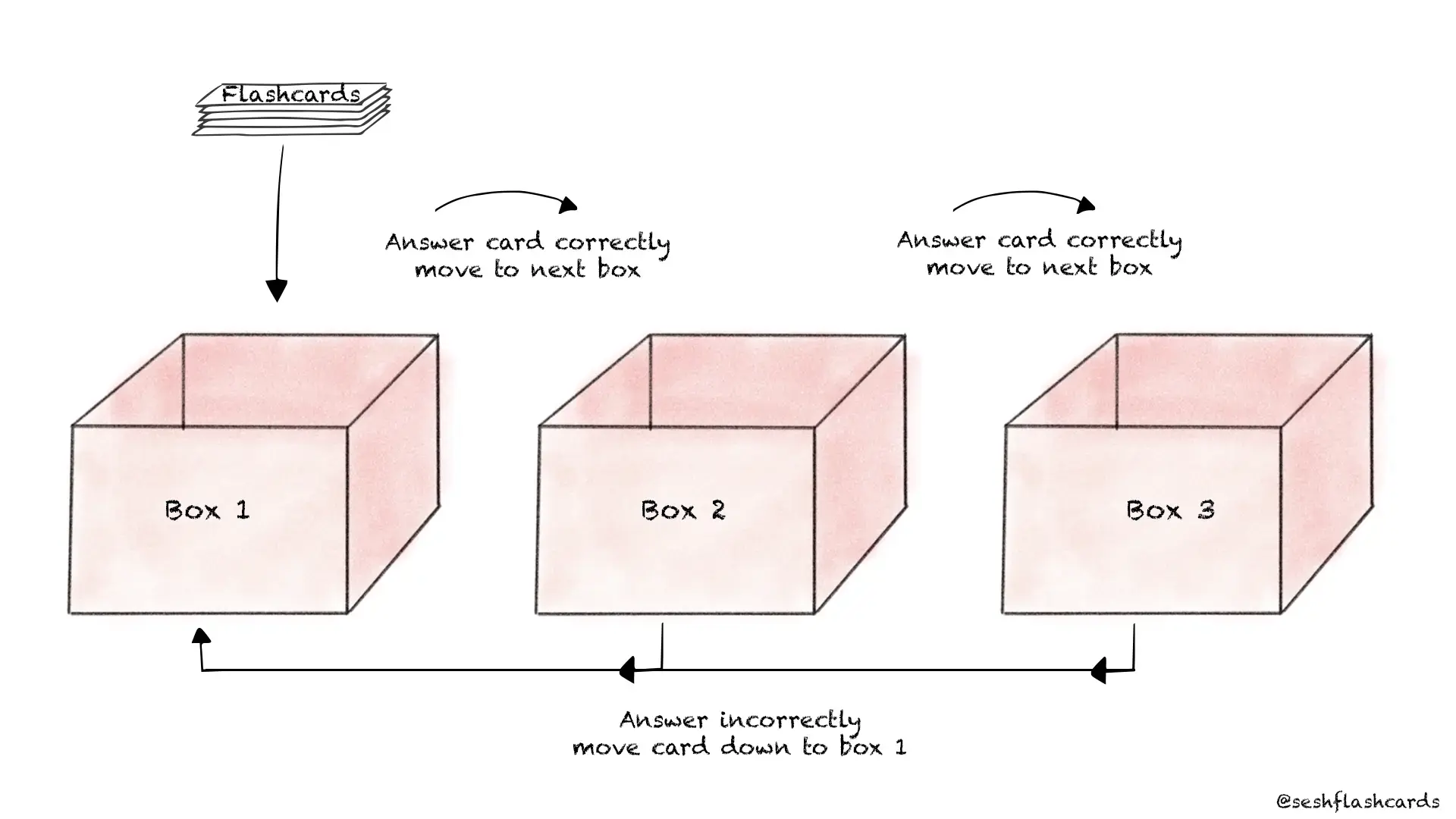
These intervals are carefully chosen based on research showing that active recall combined with short-term reinforcement significantly improves retention during the early learning stages. Once you complete these two reviews, the glyph enters Box 1 (spaced repetition starting at 1 day).
This method ensures:
- Immediate reinforcement for short-term memory.
- A smooth transition to spaced repetition for long-term retention.
Comparison to Other Systems
Many flashcard apps use a simpler approach: starting cards directly in Box 1 with a 1-day interval. While effective for advanced learners or familiar material, this method can lead to:
- Premature Forgetting: Without early reviews, new users may forget unfamiliar glyphs before the first spaced repetition occurs.
- Reduced Engagement: Beginners might struggle with confidence if they don’t retain glyphs introduced the previous day.
Our system bridges this gap by incorporating short initial bursts to prevent forgetting and build confidence, particularly for learners unfamiliar with hieroglyphs.
Why We Use Short Bursts
- Tailored to Hieroglyph Learning: Hieroglyphs demand immediate reinforcement due to their complexity. Early reviews help you distinguish subtle differences between similar-looking symbols.
- Optimized Engagement: Short intervals keep you actively engaged in learning without overwhelming you with too many reviews.
- Scientific Backing: Research on active recall and spaced practice shows that frequent exposure to new information within the first hour significantly improves retention.
What Happens After Initial Bursts?
Once you’ve completed the 10-minute and 1-hour reviews:
- The glyph transitions to Box 1, where it follows traditional spaced repetition intervals:
- 1 day → 3 days → 7 days → 14 days → 30 days > …
- This ensures long-term retention while minimizing unnecessary repetition.
If you struggle with a glyph (e.g., incorrect answers), it’s sent back to Box 1 or reviewed sooner to help you relearn it.
Frequently Asked Questions
Why not start with spaced repetition like other apps?
Starting directly with a 1-day interval works well for simpler or familiar content, but for hieroglyphs:
- Early forgetting is more likely without reinforcement.
- Short bursts ensure new learners build confidence and prevent discouragement.
What happens if I fail a card during the initial bursts?
If you answer incorrectly during the initial intervals, the card resets to the beginning of the short bursts to ensure thorough reinforcement.
Can I customize the intervals?
At the moment, the intervals are fixed to optimize hieroglyph learning. However, we may add customization options in the future based on user feedback.
Conclusion
With our innovative method combining spaced repetition and short bursts, mastering hieroglyphs is no longer an overwhelming task. Whether you're a beginner or advancing your skills, every step you take brings you closer to mastering one of the most fascinating written languages in history. Trust that every review is purposefully designed to help you succeed in your learning journey—efficiently, effectively, and confidently.